 Add to Chrome
 Add to Firefox
 Add to Edge
PAPO-VLA: Planning-Aware Policy Optimization for Vision-Language-Action Models
May 19, 2026
Vision-Language-Action (VLA) models show promising ability in language-guided robotic tasks. However, making VLA policies reliable remains challenging, because a manipulation task is completed through closed-loop interaction, where each action affects subsequent execution. To analyze this problem, we revisit VLA policy during execution and argue that a VLA policy acts both as a planner, which makes task-oriented decisions that change the direction of execution, and as an executor, which realizes these decisions through dense continuous actions. This view suggests that improving VLA reliability requires particular attention to planning actions. Existing optimization methods can imitate actions or improve complete trajectories, but they usually do not explicitly identify planning actions or measure their importance for task success. To address this issue, we propose Planning-Aware Policy Optimization for VLA models (PAPO-VLA). PAPO-VLA first identifies planning actions by jointly considering action variation and trajectory outcome, then estimates their importance through causal sufficiency and causal necessity, and finally incorporates this importance into GRPO advantage estimation. In this way, more important planning actions receive stronger optimization emphasis, while the whole trajectory is still optimized by trajectory-level feedback. Experiments on multiple benchmarks demonstrate the effectiveness of PAPO-VLA.

CAMD: Coverage-Aware Multimodal Decoding for Efficient Reasoning of Multimodal Large Language Models
Mar 16, 2026Recent advances in Multimodal Large Language Models (MLLMs) have shown impressive reasoning capabilities across vision-language tasks, yet still face the challenge of compute-difficulty mismatch. Through empirical analyses, we identify that existing decoding methods may waste compute on easy cases while underserving hard ones, affecting both model effectiveness and efficiency. To address this issue, we first develop a theoretical framework that links sampling coverage, instance difficulty, and residual risk. Our analysis reveals that multimodal reasoning exhibits a heavy-tailed difficulty distribution; a small subset of hard or ambiguous samples dominates the residual failure probability. Based on this insight, we propose Coverage-Aware Multimodal Decoding (CAMD), an adaptive inference mechanism that dynamically allocates computation according to estimated uncertainty. CAMD integrates evidence-weighted scoring, posterior coverage estimation, and sequential Bayesian updating to balance efficiency and reliability under a limited token budget. Experiments on various benchmark datasets and baselines demonstrate the effectiveness and advantages of our approach.
Towards Generalizable Reasoning: Group Causal Counterfactual Policy Optimization for LLM Reasoning
Feb 06, 2026Large language models (LLMs) excel at complex tasks with advances in reasoning capabilities. However, existing reward mechanisms remain tightly coupled to final correctness and pay little attention to the underlying reasoning process: trajectories with sound reasoning but wrong answers receive low credit, while lucky guesses with flawed logic may be highly rewarded, affecting reasoning generalization. From a causal perspective, we interpret multi-candidate reasoning for a fixed question as a family of counterfactual experiments with theoretical supports. Building on this, we propose Group Causal Counterfactual Policy Optimization to explicitly train LLMs to learn generalizable reasoning patterns. It proposes an episodic causal counterfactual reward that jointly captures (i) robustness, encouraging the answer distribution induced by a reasoning step to remain stable under counterfactual perturbations; and (ii) effectiveness, enforcing sufficient variability so that the learned reasoning strategy can transfer across questions. We then construct token-level advantages from this reward and optimize the policy, encouraging LLMs to favor reasoning patterns that are process-valid and counterfactually robust. Extensive experiments on diverse benchmarks demonstrate its advantages.
On the Plasticity and Stability for Post-Training Large Language Models
Feb 06, 2026Training stability remains a critical bottleneck for Group Relative Policy Optimization (GRPO), often manifesting as a trade-off between reasoning plasticity and general capability retention. We identify a root cause as the geometric conflict between plasticity and stability gradients, which leads to destructive interference. Crucially, we argue that deterministic projection methods are suboptimal for GRPO as they overlook the intrinsic stochasticity of group-based gradient estimates. To address this, we propose Probabilistic Conflict Resolution (PCR), a Bayesian framework that models gradients as random variables. PCR dynamically arbitrates conflicts via an uncertainty-aware ``soft projection'' mechanism, optimizing the signal-to-noise ratio. Extensive experiments demonstrate that PCR significantly smooths the training trajectory and achieves superior performance in various reasoning tasks.
Enhancing Large Language Models for Time-Series Forecasting via Vector-Injected In-Context Learning
Jan 12, 2026The World Wide Web needs reliable predictive capabilities to respond to changes in user behavior and usage patterns. Time series forecasting (TSF) is a key means to achieve this goal. In recent years, the large language models (LLMs) for TSF (LLM4TSF) have achieved good performance. However, there is a significant difference between pretraining corpora and time series data, making it hard to guarantee forecasting quality when directly applying LLMs to TSF; fine-tuning LLMs can mitigate this issue, but often incurs substantial computational overhead. Thus, LLM4TSF faces a dual challenge of prediction performance and compute overhead. To address this, we aim to explore a method for improving the forecasting performance of LLM4TSF while freezing all LLM parameters to reduce computational overhead. Inspired by in-context learning (ICL), we propose LVICL. LVICL uses our vector-injected ICL to inject example information into a frozen LLM, eliciting its in-context learning ability and thereby enhancing its performance on the example-related task (i.e., TSF). Specifically, we first use the LLM together with a learnable context vector adapter to extract a context vector from multiple examples adaptively. This vector contains compressed, example-related information. Subsequently, during the forward pass, we inject this vector into every layer of the LLM to improve forecasting performance. Compared with conventional ICL that adds examples into the prompt, our vector-injected ICL does not increase prompt length; moreover, adaptively deriving a context vector from examples suppresses components harmful to forecasting, thereby improving model performance. Extensive experiments demonstrate the effectiveness of our approach.
Exploring Transferability of Self-Supervised Learning by Task Conflict Calibration
Nov 16, 2025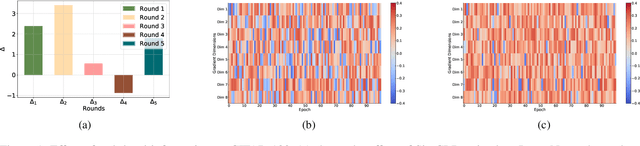
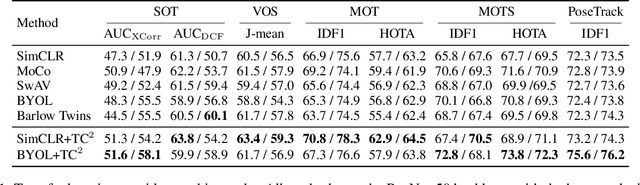
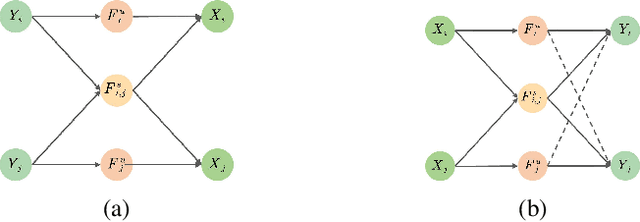
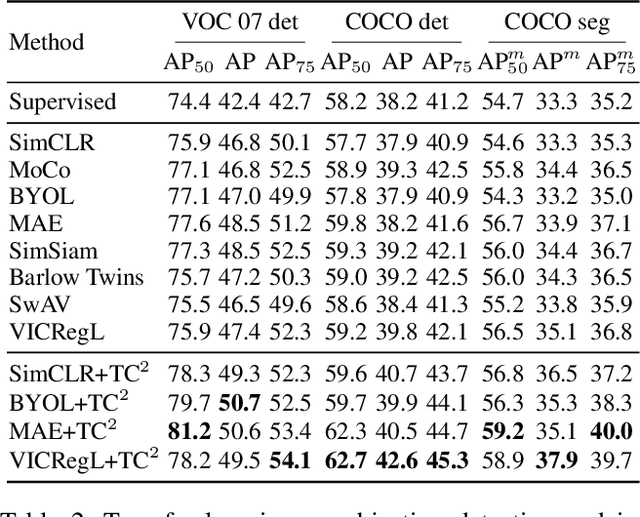
In this paper, we explore the transferability of SSL by addressing two central questions: (i) what is the representation transferability of SSL, and (ii) how can we effectively model this transferability? Transferability is defined as the ability of a representation learned from one task to support the objective of another. Inspired by the meta-learning paradigm, we construct multiple SSL tasks within each training batch to support explicitly modeling transferability. Based on empirical evidence and causal analysis, we find that although introducing task-level information improves transferability, it is still hindered by task conflict. To address this issue, we propose a Task Conflict Calibration (TC$^2$) method to alleviate the impact of task conflict. Specifically, it first splits batches to create multiple SSL tasks, infusing task-level information. Next, it uses a factor extraction network to produce causal generative factors for all tasks and a weight extraction network to assign dedicated weights to each sample, employing data reconstruction, orthogonality, and sparsity to ensure effectiveness. Finally, TC$^2$ calibrates sample representations during SSL training and integrates into the pipeline via a two-stage bi-level optimization framework to boost the transferability of learned representations. Experimental results on multiple downstream tasks demonstrate that our method consistently improves the transferability of SSL models.
Group Causal Policy Optimization for Post-Training Large Language Models
Aug 07, 2025Recent advances in large language models (LLMs) have broadened their applicability across diverse tasks, yet specialized domains still require targeted post training. Among existing methods, Group Relative Policy Optimization (GRPO) stands out for its efficiency, leveraging groupwise relative rewards while avoiding costly value function learning. However, GRPO treats candidate responses as independent, overlooking semantic interactions such as complementarity and contradiction. To address this challenge, we first introduce a Structural Causal Model (SCM) that reveals hidden dependencies among candidate responses induced by conditioning on a final integrated output forming a collider structure. Then, our causal analysis leads to two insights: (1) projecting responses onto a causally informed subspace improves prediction quality, and (2) this projection yields a better baseline than query only conditioning. Building on these insights, we propose Group Causal Policy Optimization (GCPO), which integrates causal structure into optimization through two key components: a causally informed reward adjustment and a novel KL regularization term that aligns the policy with a causally projected reference distribution. Comprehensive experimental evaluations demonstrate that GCPO consistently surpasses existing methods, including GRPO across multiple reasoning benchmarks.
Hacking Hallucinations of MLLMs with Causal Sufficiency and Necessity
Aug 06, 2025
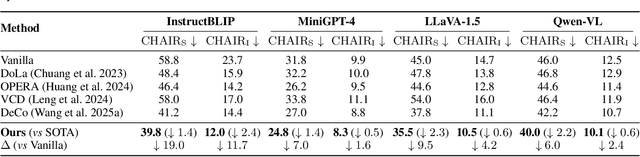
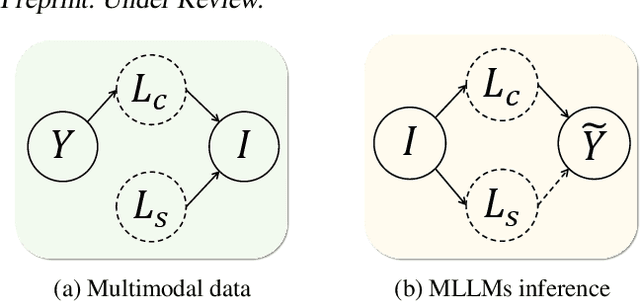
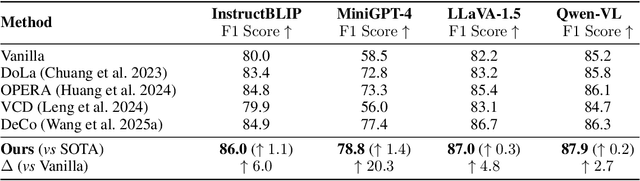
Multimodal Large Language Models (MLLMs) have demonstrated impressive capabilities across vision-language tasks. However, they may suffer from hallucinations--generating outputs that are semantically inconsistent with the input image or text. Through causal analyses, we find that: (i) hallucinations with omission may arise from the failure to adequately capture essential causal factors, and (ii) hallucinations with fabrication are likely caused by the model being misled by non-causal cues. To address these challenges, we propose a novel reinforcement learning framework guided by causal completeness, which jointly considers both causal sufficiency and causal necessity of tokens. Specifically, we evaluate each token's standalone contribution and counterfactual indispensability to define a token-level causal completeness reward. This reward is used to construct a causally informed advantage function within the GRPO optimization framework, encouraging the model to focus on tokens that are both causally sufficient and necessary for accurate generation. Experimental results across various benchmark datasets and tasks demonstrate the effectiveness of our approach, which effectively mitigates hallucinations in MLLMs.
Advancing Complex Wide-Area Scene Understanding with Hierarchical Coresets Selection
Jul 17, 2025Scene understanding is one of the core tasks in computer vision, aiming to extract semantic information from images to identify objects, scene categories, and their interrelationships. Although advancements in Vision-Language Models (VLMs) have driven progress in this field, existing VLMs still face challenges in adaptation to unseen complex wide-area scenes. To address the challenges, this paper proposes a Hierarchical Coresets Selection (HCS) mechanism to advance the adaptation of VLMs in complex wide-area scene understanding. It progressively refines the selected regions based on the proposed theoretically guaranteed importance function, which considers utility, representativeness, robustness, and synergy. Without requiring additional fine-tuning, HCS enables VLMs to achieve rapid understandings of unseen scenes at any scale using minimal interpretable regions while mitigating insufficient feature density. HCS is a plug-and-play method that is compatible with any VLM. Experiments demonstrate that HCS achieves superior performance and universality in various tasks.
Multi-Modal Learning with Bayesian-Oriented Gradient Calibration
May 29, 2025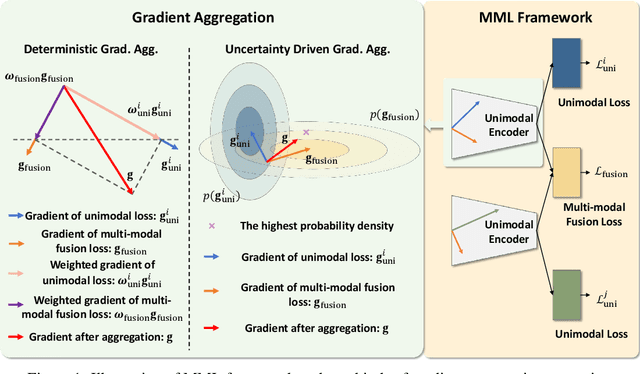
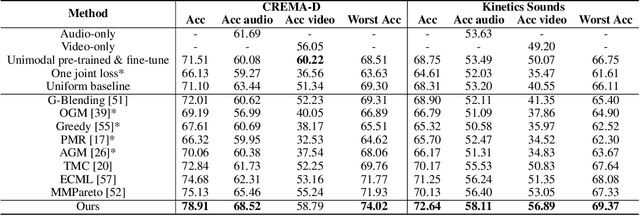
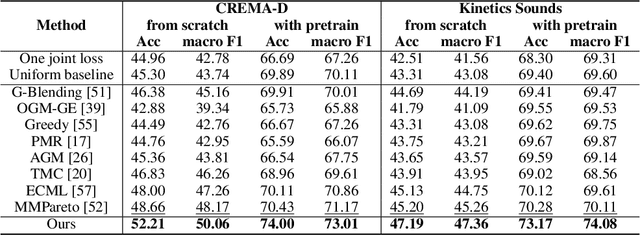
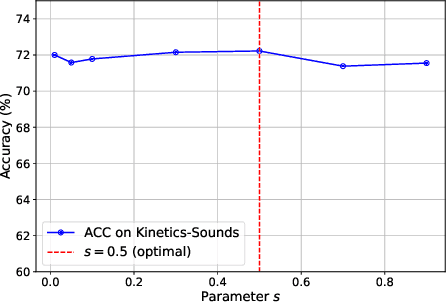
Multi-Modal Learning (MML) integrates information from diverse modalities to improve predictive accuracy. However, existing methods mainly aggregate gradients with fixed weights and treat all dimensions equally, overlooking the intrinsic gradient uncertainty of each modality. This may lead to (i) excessive updates in sensitive dimensions, degrading performance, and (ii) insufficient updates in less sensitive dimensions, hindering learning. To address this issue, we propose BOGC-MML, a Bayesian-Oriented Gradient Calibration method for MML to explicitly model the gradient uncertainty and guide the model optimization towards the optimal direction. Specifically, we first model each modality's gradient as a random variable and derive its probability distribution, capturing the full uncertainty in the gradient space. Then, we propose an effective method that converts the precision (inverse variance) of each gradient distribution into a scalar evidence. This evidence quantifies the confidence of each modality in every gradient dimension. Using these evidences, we explicitly quantify per-dimension uncertainties and fuse them via a reduced Dempster-Shafer rule. The resulting uncertainty-weighted aggregation produces a calibrated update direction that balances sensitivity and conservatism across dimensions. Extensive experiments on multiple benchmark datasets demonstrate the effectiveness and advantages of the proposed method.